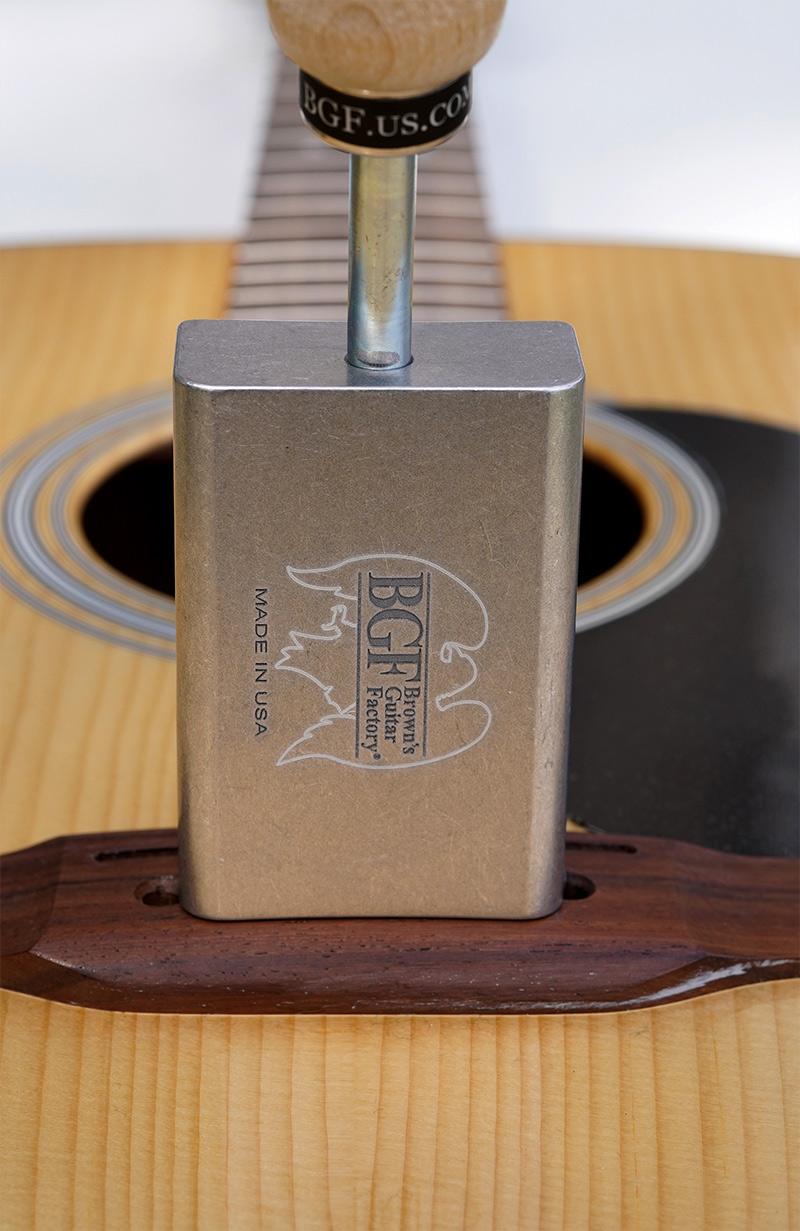
BGF Conversion Post – The Original (Aged Nickel)
- June 25th, 2016
- Write comment
Locking Conversion Post
This high precision mini jack is a real time-saver for clamping braces, bridge plates, and crack repair cleats while the glue dries.
A special tool for applying heat to a fingerboard extension or acoustic guitar bridge, to soften the glue for easier removal. This 2-7/8″ x 2″ x 1″ aluminum hand iron is designed to be heated on your hot plate to 250 degrees. The iron’s underside is radiused and relieved for the higher frets on Martin and Gibson guitars that have 14 frets to the body. The frets need not be removed. The wooden handle is positioned over the fretboard, giving you room to work with a removal knife to help break the glue bond. The edges of the iron are radiused for efficiently transferring heat to an acoustic guitar bridge.
Low-friction files for fret ends.
Sold individually or SAVE when you buy the set of both files.
The Fret Beveling File is the fast, accurate way to put a uniform 35° bevel on fret ends after installing new frets. With a quick, smooth motion, this file angles the fret ends and makes them ready for fret dressing and polishing. Available in either 3-3/4″ or 7-1/2″ filing lengths.
This 1-1/2″ x 1-3/4″ block (two lengths are available) holds a removable fine-tooth flat file at the proper 35° angle to bevel all the fret ends along the edge of the fingerboard. The block is made of low-friction material for smooth, easy filing. The 3-3/4″ model is for short fingerboards (mandolins, for example), and for spot-filing partial refrets. It’s also useful for working on used instruments with necks that aren’t straight.
3-3/4″ replacement file only
This 1-1/2″ x 1-3/4″ block (two lengths are available) holds a removable fine-tooth flat file at the proper 35° angle to bevel all the fret ends along the edge of the fingerboard. The block is made of low-friction material for smooth, easy filing. The 3-3/4″ model is for short fingerboards (mandolins, for example), and for spot-filing partial refrets. It’s also useful for working on used instruments with necks that aren’t straight.
Low-friction files for fret ends.
Sold individually or SAVE when you buy the set of both files.
The Fret Beveling File is the fast, accurate way to put a uniform 35° bevel on fret ends after installing new frets. With a quick, smooth motion, this file angles the fret ends and makes them ready for fret dressing and polishing. Available in either 3-3/4″ or 7-1/2″ filing lengths.
This 1-1/2″ x 1-3/4″ block (two lengths are available) holds a removable fine-tooth flat file at the proper 35° angle to bevel all the fret ends along the edge of the fingerboard. The block is made of low-friction material for smooth, easy filing. The 3-3/4″ model is for short fingerboards (mandolins, for example), and for spot-filing partial refrets. It’s also useful for working on used instruments with necks that aren’t straight.
7-1/2″ replacement file only
This 1-1/2″ x 1-3/4″ block (two lengths are available) holds a removable fine-tooth flat file at the proper 35° angle to bevel all the fret ends along the edge of the fingerboard. The block is made of low-friction material for smooth, easy filing. The 3-3/4″ model is for short fingerboards (mandolins, for example), and for spot-filing partial refrets. It’s also useful for working on used instruments with necks that aren’t straight.
Reset loose fret ends without restringing! Simply fit end of this handy tool over the crown of a fret, and tap with a hammer.
This is a simple little tool that can make your fret reseating jobs a lot quicker and easier. The end of the tool is machined to fit over the crown of the fret, and you simply tap the tool with a hammer. Its narrow contact surface makes short work of reseating loose fret ends, and you can use it even when the strings are still on the instrument. Hold it by hand for supergluing a loose fret end: it makes a great spot caul for pressing the fret down while the glue sets. The machined brass Fret Setter wide sku: 1662 is 5″ long with a 3/8″ fret contact surface, and works well for wide fretwire. Setters are available for wide, medium, and narrow fretwires.
The Fret Setter narrow (SKU: 1632) works for Stew Mac’s # 0764 Narrow/Low fretwire which is used for modern standard mandolin, ukulele, and old-style small banjo fretwire.
Flammable: Cannot ship by air or outside the USA.
Beautifies and Protects
A penetrating feeder and preservative for guitar finishes and natural woods. Polishes to a soft luster leaving only the light scent of oranges.
The unique blend of beeswax, carnauba wax and orange oil enhances the natural beauty and depth of grain in finished and unfinished woods. Guitar Elixer prevents further drying and deterioration of the finish.
This special open-end wrench is only .075″ slim. It’s designed to easily access the thin 1/2″ mounting nut on an acoustic guitar endpin jack, without marring the nut. The other end accesses a 14mm mounting nut on a flush-mount output jack, usually hard to reach, as found on many solid-body guitars. It is a handy tool for effects pedals and other flush-mount jacks as well.
7″ length for controlled ergonomic adjustment.
High quality corrosive resistant stainless steel proudly made in the USA.
A reliable way to remove an acoustic guitar bridge reinforcement plate while avoiding serious damage to the soundboard. The universal 5-sided base retains heat to soften the glue for a variety of bridge plate sizes. It’s 5⁄8″ thick aluminum base retains optimum heat with an overall size for easy maneuvering.
Extremely versatile with the through bridge, six position, clamping option. The iron can be secured in place by tightening a hex screw through the bridge pin hole. This can be a handy option for certain stages of the removal process.
Needle and hose adapter only
Injecting steam into the dovetail neck joint, through a small hole drilled in a fret slot, helps loosen the glue for neck removal. We originally designed this with the pressure cooker in mind as a steam source. Extra-long 3-1/2″ x 5/64″ injector needle and 3/8″ O.D. brass hose adapter with finger grip. (Use your own hose and clamp)
Aligns your hand drill for accurate tuning machine mounting pin holes.
This anodized hard coated aluminum jig accurately locates mounting pin holes in the back of a guitar headstock. Use it before drilling for the alignment pins found on many modern enclosed tuning machines. These tuners don’t use the traditional exposed tuner mounting screw, but rather a hidden pin on the underside of the tuner housing.
It keeps your hand drill perpendicular for accuracy, and works for left or right-side tuners. You can position single-pin Schaller tuners, two-pin Schallers, one-pin Sperzels, and Fender locking tuners. The jig fits into the peghole with a self-centering bushing and thumbscrew for quick and easy attachment. Instructions included.
This jig is designed for use with a No. 38 (.101″) drill bit. Measure the height of the alignment pins on your tuners and drill the holes to the appropriate depth.
Accurate mounting screw alignment! Here’s a handy little jig that keeps your 5/64″ drill bit squarely aligned at the right locations for Waverly tuner mounting screws.
The 1″ hole spacing matches Waverly guitar and ukulele tuners, as well as 18:1 Grover Sta-Tite machines. Works with your hand drill.
Made of finely machined anodized hard coated aluminum, the jig fits into a peghole, and attaches with a thumbscrew and self-centering collar. An easy solution for repair shops and luthiers who demand trouble-free, accurate tuner installations.
Instructions included.